CONTEXT — BEFORE YOU READ
John opens his Gospel differently from Matthew, Mark, and Luke. Those three start with Jesus' birth or the beginning of His ministry. John starts before time itself: “in the beginning was the Word.” He is making a claim from his very first sentence; Jesus is not a new development in God's story. He has been part of it from before creation.
Hebrews 1 gives you the historical frame. God has always been speaking; through creation, through the law, through the prophets over centuries. But those prophets were pointing forward to something greater. The Son is not another prophet in a long line. He is the one the whole line was pointing to. The signal God has been sending across all human history reaches its pinnacle expression in Jesus.
Hebrews 1 gives you the historical frame. God has always been speaking; through creation, through the law, through the prophets over centuries. But those prophets were pointing forward to something greater. The Son is not another prophet in a long line. He is the one the whole line was pointing to. The signal God has been sending across all human history reaches its pinnacle expression in Jesus.
READ — SIT WITH THIS
John 10:1–5 – “Truly, truly, I say to you, he who does not enter the sheepfold by the door but climbs in by another way, that man is a thief and a robber. 2 But he who enters by the door is the shepherd of the sheep. 3 To him the gatekeeper opens. The sheep hear his voice, and he calls his own sheep by name and leads them out. 4 When he has brought out all his own, he goes before them, and the sheep follow him, for they know his voice. 5 A stranger they will not follow, but they will flee from him, for they do not know the voice of strangers.”
John 1:14 - "And the Word became flesh and dwelt among us, and we have seen his glory, glory as of the only Son from the Father, full of grace and truth."
Hebrews 1:1-2 - "Long ago, at many times and in many ways, God spoke to our fathers by the prophets, but in these last days he has spoken to us by his Son, whom he appointed the heir of all things, through whom also he created the world."
Read John 1:1-5a second time slowly. The Word was with God. The Word was God. And then in verse 14 — the Word became one of us. Sit with the weight of what that says for a moment.
REFLECT — 5 QUESTIONS
Take your time with these. There are no right answers to perform. The point is to prayerfully reflect on what God is saying.
1. Before today, if someone asked you what God was trying to communicate to the human race He created, what would you have said? Has anything developed or shifted after reading these passages?
2. John says the Word became flesh and "dwelt among us." The original word means pitched a tent (pointing back to the tabernacle in the Old Testament). What does it mean to you that God did not manage things from a distance but actually joined us in the chaos humans have created?
3. The Cross holds justice and mercy at the same time. Pure forgiveness without consequence is not fully just. Pure punishment without a way back is not merciful. Which of those two truths — that God is just, or that God is merciful — is harder for you to actually accept right now, and why?
4. Jesus spoke with an authority that was immediately different from anyone else. "You have heard it said — but I say to you." If you were in that crowd and heard someone talk that way, what would your reaction have been? What is your reaction when God speaks with authority into your life and world now?
5. Hebrews says God has been speaking across all of human history, and that the clearest signal He has ever sent is Jesus. How much time are you currently spending getting to know what Jesus said and did? Be honest about the gap between your answer and your actual calendar on any given week.
1. Before today, if someone asked you what God was trying to communicate to the human race He created, what would you have said? Has anything developed or shifted after reading these passages?
2. John says the Word became flesh and "dwelt among us." The original word means pitched a tent (pointing back to the tabernacle in the Old Testament). What does it mean to you that God did not manage things from a distance but actually joined us in the chaos humans have created?
3. The Cross holds justice and mercy at the same time. Pure forgiveness without consequence is not fully just. Pure punishment without a way back is not merciful. Which of those two truths — that God is just, or that God is merciful — is harder for you to actually accept right now, and why?
4. Jesus spoke with an authority that was immediately different from anyone else. "You have heard it said — but I say to you." If you were in that crowd and heard someone talk that way, what would your reaction have been? What is your reaction when God speaks with authority into your life and world now?
5. Hebrews says God has been speaking across all of human history, and that the clearest signal He has ever sent is Jesus. How much time are you currently spending getting to know what Jesus said and did? Be honest about the gap between your answer and your actual calendar on any given week.
MY ' I WILL' STATEMENT
Sample: I will read one chapter of the Gospel of Mark every day this week to hear what God's statement sounds like in Jesus' own words and actions.
This week, because of what God has shown me in His Word, I will:
PRAYER
Write your prayer or pray out loud. No need for formal words. You can talk to him like a close friend or loving father.
MEMORY VERSE
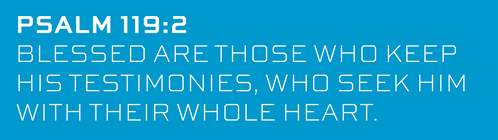
Write or recite Psalm 119:2 (the weekly verse) from memory: